


Ever seen a car at night that seems to float on a pool of vibrant colour and wondered how it’s done? You’re looking at car under lights, a customisation that completely changes a vehicle's character after sunset. This effect, widely known as 'underglow', uses carefully placed lights to create an eye-catching, almost ethereal look on the road.
What Are Car Under Lights and How Do They Work?
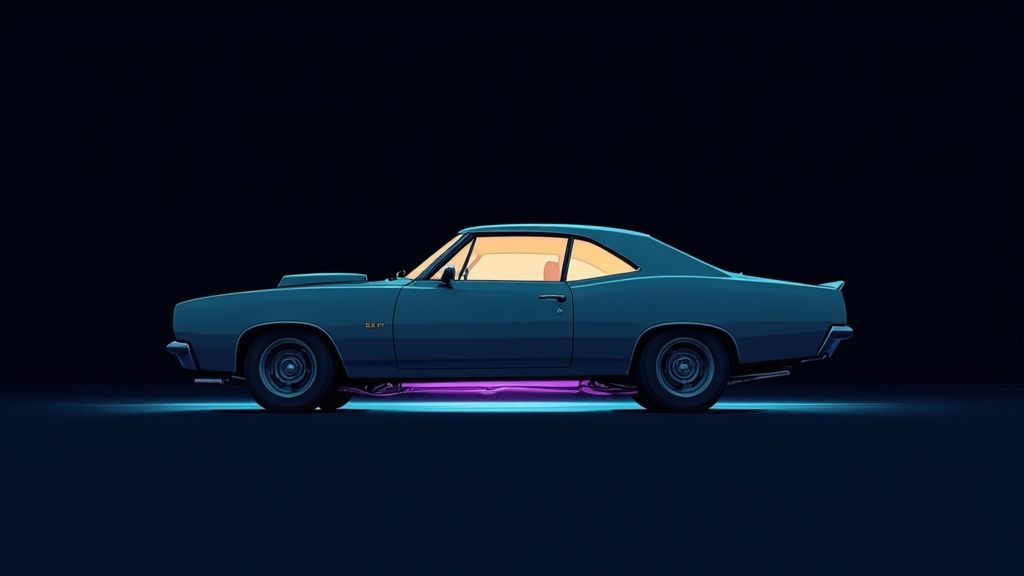
Think of it as giving your car a secret identity that only reveals itself after dark. At its most basic, this modification involves fixing light sources—almost always LED strips these days—to the hidden parts of your car’s chassis. When you flick the switch, they project a rich, colourful light onto the ground, making your car look like it’s hovering.
But it’s about more than just a cool visual trick; for many car enthusiasts, it’s a form of personal expression. The whole underglow trend grew out of the custom car scene, becoming a signature look at car shows and late-night gatherings. Now, thanks to some serious tech upgrades, what was once a complex, niche modification is easier to achieve than ever. We've come a long way from clunky, single-colour bulbs.
Two Main Types of Car Lighting
When you get into custom lighting, you'll find it generally falls into two camps. Each has a different goal, but they often work together to create a cohesive, personalised vibe.
- Exterior Underglow Kits: This is the classic setup. The lights are mounted to the undercarriage, and their whole purpose is to light up the road beneath the car, creating that iconic 'floating' effect.
- Interior Ambient Lighting: This is all about enhancing the cabin. LED strips are fitted inside—think footwells, under seats, or tucked along the dashboard. The goal is to create a more immersive and stylish atmosphere for the driver and passengers.
At its heart, adding lights to your car is about making a statement. It’s a way to blend technology with personal style, turning a standard vehicle into a unique piece of rolling art that reflects the owner's taste.
The Evolution from Niche to Mainstream
The journey of car under lights from the underground tuning world to something you might see on your daily commute is really a story of technology catching up. The first-generation systems were often fragile, power-hungry, and stuck on one colour. Today, the game has completely changed, with flexible, tough, and incredibly dynamic LED tech leading the way.
Modern kits, including the versatile options in our car lighting collection, are often controlled right from your smartphone. This gives you the freedom to pick any colour you can imagine, set up dazzling animated patterns, and even sync the lights to pulse with your music. That level of customisation has unlocked a huge range of creative possibilities, letting drivers perfectly match their car's look to their mood.
This guide will walk you through everything you need to know, from the technology and UK laws to installation and styling ideas.
Understanding the Technology Behind Modern Car Lighting
If you want to truly personalise your ride, it helps to get your head around what’s actually making that glow happen. The world of car under lights has come a long way from the simple, single-colour bulbs of the past. Today’s wild, dynamic effects are pretty much all down to one star player: the LED.
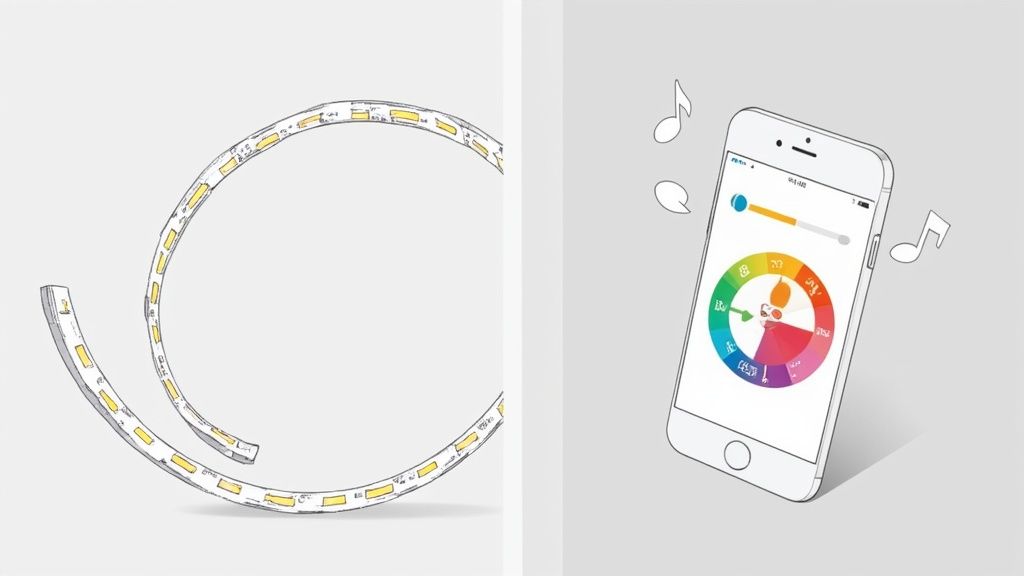
LED stands for Light Emitting Diode. Just think of them as tiny, super-bright, and incredibly efficient light sources. Old-school incandescent bulbs wasted most of their energy creating heat, but LEDs turn a huge chunk of their electricity straight into light. That efficiency is a big deal for a car, where you really don’t want to be putting your battery under any unnecessary strain.
It’s exactly why they’ve become the go-to not just for underglow, but for everything from fancy headlights to the ambient lighting inside high-end cabins. They're also tough as nails, which makes them perfect for the rough-and-tumble environment underneath a car, where they have to put up with constant vibrations, water, and road muck.
Flexible Strips vs Rigid Bars
When you start shopping for a kit, you'll generally find two main physical types of LED lighting. Each has its own job, and picking the right one comes down to where you plan to stick them.
- Flexible LED Strips: There’s a reason these are the most common choice. They come on a bendy ribbon, which lets you wrap them around the curves and contours of your car’s chassis. That flexibility is key for getting a clean, unbroken line of light down the sides and around the front and back.
- Rigid LED Bars: These are exactly what they sound like—straight, solid bars of light. While you can't bend them, they’re fantastic for long, straight sections under the car. They give you a perfectly even beam and are often a bit more durable thanks to their solid housing.
Honestly, the best kits often give you a mix of both. You might get rigid bars for the long side sections and shorter, flexible strips to handle the bumpers. This hybrid approach is the secret to getting complete, even coverage with no awkward dark spots, making the whole setup look pro.
The Evolution of Smart Control
The real magic of modern underglow is in how you control it. The days of fumbling for a clunky on/off switch tucked under your dash are well and truly over. Today, it’s all about smart, customisable control that puts a universe of options right in your pocket.
The heart of the system is the controller module—a little black box that's basically the brain of the operation. This unit takes your commands and tells the LEDs precisely what colour to be, how bright to shine, and what funky pattern to run.
The biggest leap forward has been the integration of Bluetooth technology. By connecting the controller to a smartphone app, users can now access millions of colour combinations and dynamic effects that were previously unimaginable.
This app-based control opens up a level of personalisation that you’ll see in high-end gaming setups and smart home lighting. You can dial in any colour from the spectrum, tweak the brightness, and pick from dozens of pre-set animations like strobing, fading, and chasing effects.
Understanding RGB and RGBIC Technology
As you browse different kits, you'll see "RGB" and "RGBIC" thrown around a lot. They sound almost the same, but the difference between them is huge in terms of what you can creatively achieve.
RGB (Red, Green, Blue): This is your standard for multi-colour LEDs. With an RGB strip, all the LEDs have to be the same single colour at any one time. You can have solid red, solid blue, or any other colour you can mix, but the whole strip will be one uniform colour.
RGBIC (Red, Green, Blue - Independent Control): This is where things get really interesting. The 'IC' stands for Independent Control, which means every single LED (or a small group of them) has its own little chip. This allows you to display multiple colours on the very same strip, all at once.
This independent control is what unlocks those jaw-dropping effects:
- Rainbow Chasing: Create flowing, multi-coloured patterns that look like they're chasing each other down the length of your car.
- Music Sync: The lights can literally dance to the beat of your music, with different colours pulsing and moving in time with the sound.
- Complex Animations: Think flowing gradients, segmented colour schemes—the possibilities are virtually endless.
Knowing the difference between these technologies means you can pick a kit that actually delivers on the vision you have in your head. And while a cool underglow is great, don't forget about the basics; maintaining clarity of other car lights like headlights is just as important for overall vehicle safety and appearance.
Getting to Grips with UK Laws for Car Under Lights
Alright, you’ve picked out the perfect kit and you can already picture how incredible your car is going to look. Before you get the tools out, though, there’s one crucial hurdle: understanding the law. When it comes to custom lighting in the UK, the rules are very specific, and they’re all about keeping everyone on the road safe. Getting this wrong won’t just spoil the fun—it could land you with a fine and points on your licence.
The main piece of legislation you need to know about is The Road Vehicles Lighting Regulations 1989. It sounds like a stuffy old document, but the principles are actually quite straightforward. The law isn't there to stop you from personalising your car; it’s there to make sure your modifications don't become a hazard to other drivers.
The Golden Rules of UK Underglow
Here’s the thing about aftermarket lighting like underglow: the rules are less about whether you can fit the lights and more about how and when you use them on public roads. Believe it or not, fitting underglow kits to your car is perfectly legal. The problems only start when you flip the switch while driving on a public highway.
The regulations are designed to prevent distraction and confusion. Put yourself in another driver's shoes for a moment. A sudden, bright, or flashing light underneath a car can be incredibly distracting, especially at night. It could also be mistaken for the lights used by emergency services, which is a big no-no.
To stay on the right side of the law, just remember these simple, strict rules:
- No Red Lights at the Front: You can't show any red light at the front of your vehicle. That colour is reserved exclusively for the back of a car (think brake lights and tail lights).
- No Green Lights at All: Green lights are completely forbidden anywhere on your vehicle. They’re associated with doctors on call, so they're off-limits.
- No Flashing Lights: Any light that flashes, strobes, or alternates in colour is prohibited. These are strictly for emergency vehicles (blue), breakdown services (amber), and your indicators.
The heart of the RVLR is ensuring that any light fitted to a vehicle does not cause "dazzle or undue discomfort" to others on the road. This is the key phrase that makes using underglow while driving illegal—that glow can easily be seen as a distraction.
Direct vs Indirect Light: What’s the Difference?
Another important detail is whether the light source itself is visible. The regulations are clear that no direct bulb or diode should be seen. With underglow, the whole point is to see the glow on the road beneath the car, not the LED strip itself.
If your installation is a bit rushed and the individual LEDs are visible to other drivers, you could be breaking the rules even when you’re parked. This is where a careful, professional-style installation really pays off—it ensures the strips are tucked away properly, projecting light downwards to create that smooth ambient effect without ever showing the source.
The long history of car lighting regulations in the UK is all about finding the right balance between visibility for the driver and safety for everyone else. Modern laws like the RVLR 1989 ensure every light on a vehicle, from headlights to underglow, meets strict standards. You can learn more about how UK vehicle lighting laws have developed to see how we got to where we are today.
So, Where Can You Legally Show Off Your Lights?
If you can't cruise down the M25 with your fancy RGBIC kit lighting up the tarmac, where can you use it? The answer is simple: on private land.
- Car Shows and Events: This is where underglow truly shines. Shows are held on private grounds, making them the perfect place to switch on your lights and show off your custom setup.
- Photoshoots: Setting up a shoot in a private car park (with permission, of course) or on your own property? You're free to light it up for the camera.
- On Your Driveway: Just want to stand back and admire your handiwork at home? Go for it. As long as you’re not on a public road, you can enjoy the full display.
To make things easy, here is a quick summary of the do's and don'ts for using underglow in the UK.
UK Underglow Lighting Do's and Don'ts
| Guideline | Permitted on Public Roads? | Key Consideration |
|---|---|---|
| Fitting the Kit | Yes | It is legal to have the lights installed on your vehicle. |
| Using While Driving | No | It's illegal to have underglow on while driving on public roads. |
| Red Lights at Front | No | Red is only for the rear of the vehicle. |
| Green Lights | No | Green lights are strictly prohibited. |
| Flashing/Strobing Lights | No | These are reserved for emergency and service vehicles. |
| Stationary Use | No | Even when parked on a public road, the lights must be off. |
| Use on Private Land | Yes | Car shows, private driveways, and events are fine. |
Ultimately, the best approach is to have your underglow kit wired to a switch that's completely separate from your car's standard lighting controls. This stops you from accidentally turning them on while driving and makes it crystal clear that they're for display purposes only.
Think of them as "show lights," not "road lights." Stick to these guidelines, and you can enjoy your awesome car under lights without any legal headaches.
Getting Your Car Under Lights Installed
So, you've decided to give your car some underglow. That's the easy part. Now comes the fun bit: getting those lights out of the box and onto your vehicle. This is where your vision truly comes to life, and you've got two main roads you can take: rolling up your sleeves for a DIY job or calling in a pro to handle it.
Honestly, there's no right or wrong answer here. It all boils down to your budget, how comfortable you are with a few tools, and what you expect from the finished look. This guide will walk you through both options, giving you a clear picture of what's involved so you can make the best call for you and your ride.
The Do-It-Yourself Installation Path
For a lot of us, going the DIY route is half the fun. It’s a brilliant way to get properly acquainted with your car and feel that immense satisfaction when you stand back and see a job well done. Think of it as a weekend project with a seriously cool payoff.
Before you even think about lifting the car, let's talk tools. You don't need a full-on workshop, but having the right gear on hand will make the whole process go a lot smoother.
-
Your DIY Toolkit:
- Jack and Jack Stands: You absolutely need to get your car safely in the air to work underneath. Crucially, never get under a car that's only held up by a jack.
- Socket Set and Wrenches: These will be your best friends for disconnecting the battery and maybe popping off a few plastic panels for better access.
- Wire Strippers and Crimpers: If you want clean, solid electrical connections that won't fail you, these are a must-have.
- Zip Ties and Mounting Clips: The key to a tidy, professional-looking job. These keep wires from dangling and secure your LED strips for the long haul.
- Cleaning Supplies: A bottle of isopropyl alcohol and a few clean rags are non-negotiable for prepping the surfaces. You need them spotless for the adhesive to stick properly.
Safety First: Before you touch a single wire, do this one thing: disconnect the negative terminal of your car battery. It’s the most important safety step. It eliminates the risk of short circuits, which can fry your car's electronics or your brand-new lighting kit.
Key Steps for a DIY Underglow Fit
While every kit has its own little quirks, the basic installation process is pretty much the same across the board. The mission is simple: mount the strips securely, route the wires away from anything hot or that moves, and hook it up to power. If you’ve ever tackled a project like this before, you’ll find that many of the same principles in general DIY car accessory installation guides apply here, too.
- Map It Out: Before you peel off any adhesive backing, lay the strips out on the floor beside your car. Figure out the optimal placement—you're looking for flat, protected spots on the frame, away from road debris.
- Prep the Surface: This is the make-or-break step for adhesion. Grab your alcohol and give every single mounting point a thorough clean to get rid of any grime, wax, or grease.
- Mount the Strips: Peel and stick the strips, pressing them down firmly. But don't stop there. For a truly durable install, use the mounting clips and screws that came with the kit. Adhesive alone just won't cut it against road vibrations and British weather.
- Run and Secure Your Wires: Carefully route the wiring towards the engine bay. Use a zip tie every foot or so to fasten the cables neatly to the chassis. Keep them well clear of the exhaust, suspension parts, and the driveshaft.
- Connect to Power: The final hurdle. You'll connect the control box to a power source. Most modern kits, like the UnderGlo™ App Controlled LED Underglow Kit, come with fantastic instructions. They'll show you how to either tap into the fuse box for a super-clean, hidden setup or use a simple 12V plug if you prefer an easier option.
Opting for a Professional Installation
Look, if the idea of wiring diagrams and spending an afternoon on your back under the car doesn't exactly thrill you, getting a pro to do it is a brilliant move. Yes, it costs more, but what you're really paying for is experience, a flawless finish, and total peace of mind.
A professional installer has been here and done this countless times. They know all the tricky spots on different car models and can hide the wiring so well it looks like it was fitted at the factory. They’ll also make sure every connection is properly weatherproofed and secure—something that's vital for anything exposed to the elements.
To make things clearer on the legal side here in the UK, this simple workflow shows you the three key stages.
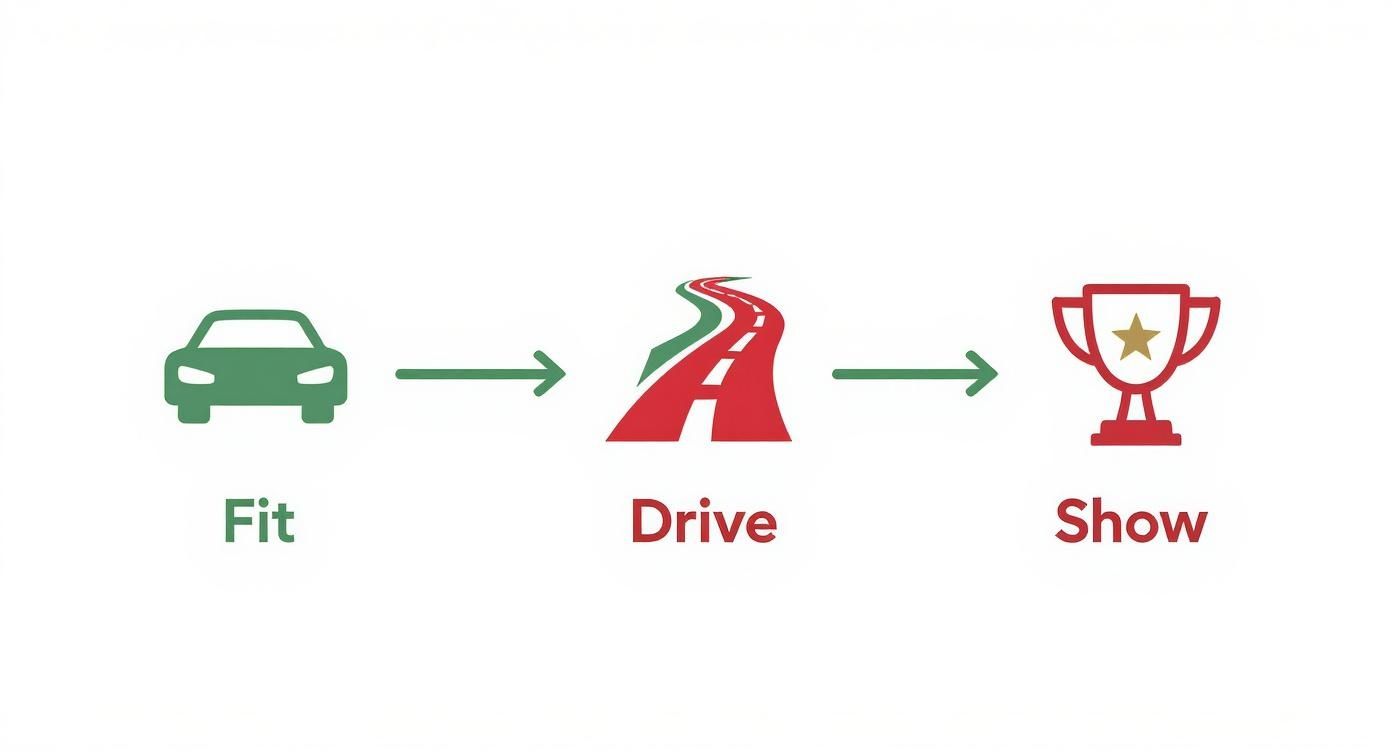
It’s a handy reminder: fitting the lights is perfectly fine, but switching them on is strictly for private land or showing off at a car meet.
When you're searching for an installer, don't be shy. Ask to see a portfolio of their work and check out their online reviews. Any reputable shop will be proud to show off what they can do and will happily chat through the best options for your specific vehicle, so you can leave it with them knowing it’s in safe hands.
Choosing Your Style With Colours and Effects
Once your car under lights are installed, the real fun begins. This is where you swap the toolbox for the colour wheel and start giving your vehicle a personality that’s all its own. The colours you choose can completely transform your car’s aesthetic, shifting its mood from aggressive and bold to sleek and sophisticated with just a tap on your phone.
Lighting is an art form, and your car is the canvas. First, think about the statement you want to make. Are you aiming for that clean, almost factory-plus look? A crisp, subtle white or a cool electric blue can create a premium, futuristic glow that beautifully complements modern vehicle designs. This style isn’t about shouting for attention; it’s about adding a touch of class.
On the other hand, if you want to turn heads at a car show, nothing beats dynamic, multi-colour effects. Imagine vibrant rainbow waves chasing each other down the length of your car or patterns pulsing in time with your music. These are the kinds of effects that stop people in their tracks and make your car the centre of attention.
Finding Your Perfect Colour Palette
With modern RGB and RGBIC systems, the sheer number of options can feel a bit overwhelming at first. The best place to start is with your car’s existing colour. The goal is to create a cohesive look where the underglow complements your paintwork, rather than clashing with it.
- For dark cars (black, grey, navy): You’ve essentially got a blank canvas. Almost any colour will pop brilliantly against a dark background. Bright reds, electric blues, and vivid greens create a stunning, high-impact contrast.
- For bright cars (white, silver, yellow): Softer colours often work best here. A cool blue, a soft purple, or even a clean white can enhance the car's lines without looking garish or over-the-top.
- For bold colours (red, blue, green): You’ve got two main routes. You can either match the paint for a powerful, unified look or choose a complementary colour for a dramatic effect. A popular choice for a red car, for example, is a pure white glow to make it really stand out.
The most effective lighting designs are those that feel intentional. By syncing your underglow with your car’s colour scheme or interior ambient lighting, you create a complete, polished look that feels professionally curated.
While having fun with your car’s glow is the whole point, it’s crucial to remember how your lighting choices could be seen by other drivers, especially when it comes to road safety. Bright, distracting lights are a real concern. In fact, a government-sponsored study found that 96% of UK drivers find some or most vehicle headlights too bright, with a quarter of those affected actually cutting back on night driving because of glare. You can find more details about how light affects drivers in the UK on RAC Drive. This really highlights why using underglow on public roads is restricted—it’s all about preventing distraction for everyone else on the road.
Unleashing Creativity with Effects and Modes
Beyond just picking a static colour, the true power of modern kits lies in their dynamic effects. App-controlled systems put a huge library of animations right at your fingertips, letting you tailor the look for any occasion.
Many enthusiasts create presets for different situations. You might set up a slow, elegant fade for a relaxed evening meet-up, then switch to a fast-paced, music-reactive mode for a high-energy car show. This level of control means your car’s lighting can adapt to its environment in seconds. Explore our range of customisable car accessories to see how different lighting and tech can be integrated.
Ultimately, choosing your style is a personal journey. Don't be afraid to play around with different colours and patterns until you find a look that perfectly represents you and your car. Whether you prefer a subtle accent or a full-on dazzling light show, the right underglow will make your vehicle uniquely yours.
Still Have Questions About Car Under Lights?
Even after getting to grips with the tech, the laws, and the installation, it's totally normal to have a few lingering questions. This section is all about tackling those common queries we hear all the time, giving you clear, straightforward answers to make sure you're completely confident before you dive in.
We'll cover everything from the nitty-gritty of UK law to the practical side of battery life and keeping your lights looking great. Think of this as your final checklist to iron out any last-minute uncertainties.
Is Underglow Actually Legal on My Car in the UK?
This is the big one, and without a doubt, the most important question for any UK driver. The answer is a bit of a "yes, but...". Yes, it's perfectly legal to fit underglow lights to your car. There's no law stopping you from installing a kit.
The crucial part is when and how you use them. The rules are all about their use on public roads. According to The Road Vehicles Lighting Regulations 1989, switching them on while driving is a definite no-go. The regulations exist to stop drivers from being distracted and to prevent any confusion with emergency service vehicles.
So, what are the hard and fast rules for road use?
- You absolutely cannot show a red light at the front of your vehicle.
- Displaying a green light anywhere on the exterior is also forbidden.
- Any lights that flash, strobe, or could be mistaken for an emergency vehicle are illegal.
What this all boils down to is that you should only ever switch on your underglow when you're on private land. This could be at a car show, a meet-up, or even just parked up on your own driveway. Get caught using them on a public road, and you're looking at a potential fine and points on your licence.
How Much Does It Cost to Install Underglow Lights?
The cost of adding underglow can swing quite a bit, depending on the kit's features and whether you fancy installing it yourself. The good news is, there's an option for almost any budget.
If you're looking to keep costs down, you can pick up a basic, single-colour DIY kit for as little as £30 to £60. These are a great entry point but are pretty limited in what they can do.
For those who want all the bells and whistles, more advanced kits with app control and dynamic modes, like RGB or RGBIC systems, typically fall in the £80 to £200+ range. These are the kits that give you millions of colour options and slick effects like syncing to your music.
Getting a professional to fit your kit will naturally add labour costs. You should expect to pay anywhere from £100 to £300 for a pro install, depending on your car and the garage's rates.
This means a top-of-the-line kit with professional installation could easily set you back over £500. It's a significant investment, for sure, but it buys you peace of mind with a clean, secure, and weatherproof finish that often includes a warranty.
Will Underglow Lights Drain My Car Battery?
That's a very fair question – nobody wants their cool lighting setup to leave them with a flat battery. Thankfully, modern LED kits are incredibly energy-efficient.
When your car's engine is running, the alternator is kicking out more than enough power to run the lights without putting any strain on the battery. Your car's electrical system is built to handle all its electronics, and a quality LED kit barely adds to that load.
The real risk is when you switch the engine off. If you leave your underglow on for hours and hours without the engine running, they will eventually drain the battery. How long that takes depends on your battery's health and how much power the kit draws, but it's a situation you'll want to avoid.
There are a few simple ways to stop this from ever being a problem:
- Wire it to an Ignition-Switched Circuit: This is the best practice. By connecting the lights to a fuse that's only live when the ignition is on, you literally can't leave them on by accident.
- Install a Master Kill Switch: A simple on/off switch inside the cabin gives you total control, letting you be 100% sure the whole system is off when you park up.
- Use a Battery Monitor: Some higher-end kits have controllers with a built-in voltage sensor. These are smart enough to automatically shut the lights off if your battery level gets too low.
What's the Best Way to Maintain Car Under Lights?
Looking after your car under lights is pretty straightforward and doesn't take much work, but a little regular care goes a long way in making them last for years. Your main goals are to keep them clean, secure, and protected from the road.
The most important job is to do regular physical checks. Once a month, just have a quick look underneath the car to make sure the LED strips are still stuck on tight. Constant road vibrations can sometimes work adhesive or mounting clips loose over time.
Keeping the lights clean is also key for both brightness and lifespan. Road grime, salt, and dirt can cake onto the protective silicone coating, which dims the light and can even degrade the material itself. A gentle wash with some car-safe soap and water is all they need.
Finally, give the wiring a quick inspection now and then, checking for any signs of rubbing or damage. Pay special attention to any spots where wires might be close to the car's chassis or suspension parts. A quick check that all connections are tight and free of corrosion will keep your kit shining bright for a long, long time.
At Cablenova, we're all about blending brilliant style with smart technology, whether it's for your car, your desk, or your pocket. Our range of innovative accessories, from dynamic underglow kits to multi-device charging stations with their own ambient lighting, is designed to help you put a personal stamp on your world. Discover our full range of high-quality tech at https://cablenova.com and light up your life.